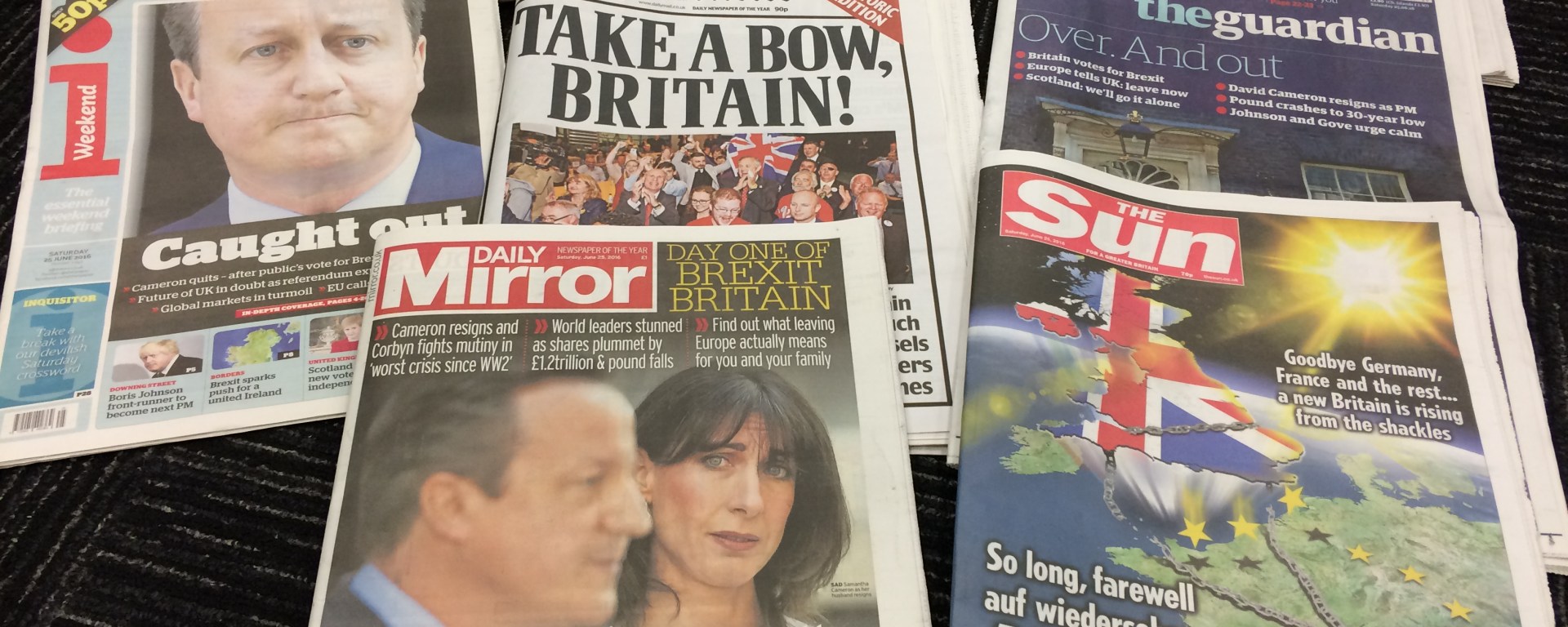
The shock result of the 2016 Brexit referendum initially caused widespread turmoil on the financial markets, along with political and economic uncertainty. I produced a daily round-up of developments for a number of high-profile clients in the City of London. Here are some extracts from the report of 25th June 2016:
Markets faced their steepest losses since the height of the global financial crisis after Friday morning’s EU referendum result, with sterling falling to its lowest level in three decades and the FTSE 100 opening 8% lower. The pound, which hit a six-month high of $1.50 late on Thursday, ended the day at $1.3629, down 8.4% but well off the day’s low of $1.3232. Meanwhile, the euro fell 2.3% against the dollar to $1.1116. Frits Vogels, head of European, Middle Eastern and African broking at ICAP, said it ‘was a little akin to markets in the aftermath of Lehman Brothers’. But as the day wore on, some of the larger market moves were tempered. The FTSE 100 eventually ended the week 2% higher than it began, and 3.2% lower on the day.
The Governor of the Bank of England led efforts to soothe markets after yesterday’s referendum result. Speaking directly to camera from the BoE, Mark Carney said the central bank ‘will not hesitate to take any additional measures required’. But he stressed that the BoE could not eliminate all the immediate damage from the vote to leave the EU. ‘There will be a period of uncertainty and adjustment following this result,’ he said, and in the longer term the UK economy will suffer because ‘the economy will adjust to new trading relationships that will be put in place over time’.
The Governor’s actions were underpinned by a series of statements from around the world, with the Federal Reserve pledging to provide dollars to other central banks if necessary to alleviate financial market turbulence. The G7 issued a statement of its own declaring that the UK’s economy and financial system were ‘resilient’, that they still sought to prevent ‘disorderly movements in exchange rates’, and were ready to pump money into the financial system ‘to support the functioning of markets’.
Shares in many of Europe’s big banks fell sharply after Friday morning’s referendum result. Among the hardest hit were British banks including Barclays, Lloyds Banking Group and Royal Bank of Scotland, which all fell more than 30% before rebounding slightly to close the day 17-21% down. Over £20bn was wiped off the market value of the three biggest UK-listed banks in a few hours, more than erasing the gains made in the past week on hopes that the country would vote to stay in the EU.
Investors also sold out of UK retailers yesterday, fearing a collapse in consumer confidence and the cost of a weaker pound after Britain voted to leave the EU. London-listed retailers lost almost a third of their value in the minutes after markets opened, before settling about 11% lower – around twice the decline in the broader market.
Thomas Cook suspended online currency purchases yesterday and imposed a £1,000 limit on high street transactions after becoming overwhelmed with orders as holidaymakers rushed to buy dollars and euros. HiFx, an online foreign exchange specialist, reported a 500% increase in business, describing the plummeting value of sterling as ‘a bloodbath for the unprepared’.
HSBC has forecast that inflation could increase to 4% within 18 months following yesterday’s collapse in the pound. The bank had previously predicted that inflation would rise to 1.7% by the end of next year. Meanwhile, one of the City’s biggest investors has raised the prospect of Britain plunging into recession by Christmas. Dominic Rossi, chief investment officer at Fidelity International, said a recession was inevitable because foreign investors would refuse to finance Britain’s current account deficit. Consumer spending would then have to fall. IHS Global Insight said it was ‘substantially’ cutting its GDP growth forecasts from 2% to 1.5% for this year and from 2.4% to just 0.2% for 2017.
In politics, Boris Johnson is odds-on favourite to become Britain’s next prime minister after David Cameron announced his resignation yesterday. The PM said he would remain in office for the next few months to ‘steady the ship’ while the Conservatives chose a new leader, but Britain needed ‘fresh leadership’ to take it in the new direction chosen by voters. In a statement, Johnson praised Cameron as ‘brave and principled’ and sought to explain how Brexit would work in practice. He stressed that nothing much would change in the short term, and there was ‘no need for haste’ in redrawing Britain’s relations with Europe. The FT says Theresa May is seen as the most likely second candidate to face Johnson on a Tory leadership shortlist.
Jeremy Corbyn faces a key test of his leadership after two veteran Labour MPs – Margaret Hodge and Ann Coffey – submitted a motion of no confidence in a bid to end his tenure as party leader. The letter calls for a discussion at a meeting of Labour MPs on Monday, where PLP chairman John Cryer will decide if it is debated. The motion could then lead to a secret ballot of Labour MPs on Tuesday. Many centrist Labour MPs feel that Corbyn campaigned halfheartedly for Remain; some have accused his office of deliberately sabotaging their efforts to keep Britain in the EU.
Scotland’s first minister has said a second independence referendum is now ‘highly likely’ after Scots bucked the national trend and voted for the UK to remain in the EU. Speaking just hours after the result was declared, Nicola Sturgeon announced legislative preparations to enable a vote that could end the Anglo-Scottish political union. The FT says her declaration highlights the potential existential threat to UK unity raised by Thursday’s 52% vote for Brexit.
 Lawrence Kuglin