On a trip to Morocco’s Saharan provinces I was bowled over by the warm hospitality of the people I met – and surprised at how safe and easy it was to travel around these remote territories...
The month before Christmas is not my favourite time of year – London is dark, cold and rainy, and the festive jingles on the radio get on my nerves. So at the end of November 2022 I set off for sunnier climes. First to Andalucia, where I spent a week hiking along the Costa de la Luz, and then by ferry across the Straits of Gibraltar to Morocco…
I spent a pleasant few days wandering around the medina of Tangier, then took the high speed train down to Morocco’s likeable capital Rabat. So far, so familiar – having been to both cities several times, I felt very much at home. In the evenings I’d order mint tea at a favourite café, sit back and savour the neverending spectacle of Moroccan street life.
But this time I was heading much further south. In the second week of December I took a train to Casablanca airport and boarded a Royal Air Maroc flight to Dakhla in Western Sahara…
Is it safe?
I’d long been intrigued by the vast desert lands that appear on our maps as Western Sahara. A Spanish colony until 1975, the territory (one of the most sparsely populated on Earth) became the object of a protracted tussle between Morocco, Mauritania and Sahrawi nationalists. I knew that Western Sahara was now a fully integrated part of the Kingdom of Morocco – but was it safe to visit, I wondered?
If you read the UK Foreign Office travel advice, you might be put off going at all. “Western Sahara is a disputed territory and the UK regards its status as undetermined,” it says. “There is no British diplomatic presence in Western Sahara and consular support is severely limited.” It adds: “The level of road safety is poor. There is a high risk of unexploded mines in remote areas.”
Well it so happens that a friend of mine lives in Dakhla, the second largest city in Western Sahara. I met him on a bus in Morocco back in 2017 and we stayed in touch throughout the pandemic. Yassin is a smart young guy who works at a bank and speaks good English. So I thought I’d fly down and visit him in his home city – and make up my own mind.
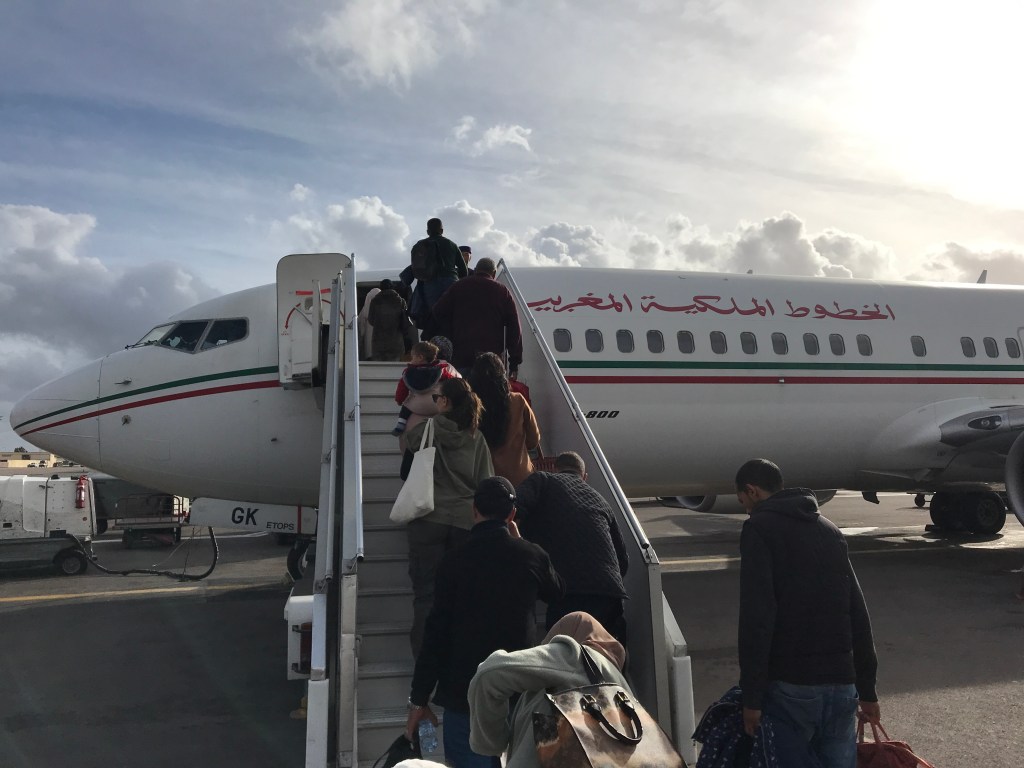
The trip began well. Check-in at Casa airport was quick and friendly (“He speaks Arabic!” the young woman called to her colleague, smiling as she pointed at me). As it was an internal Moroccan flight, I was guided to the blissfully calm and uncrowded domestic departure hall.
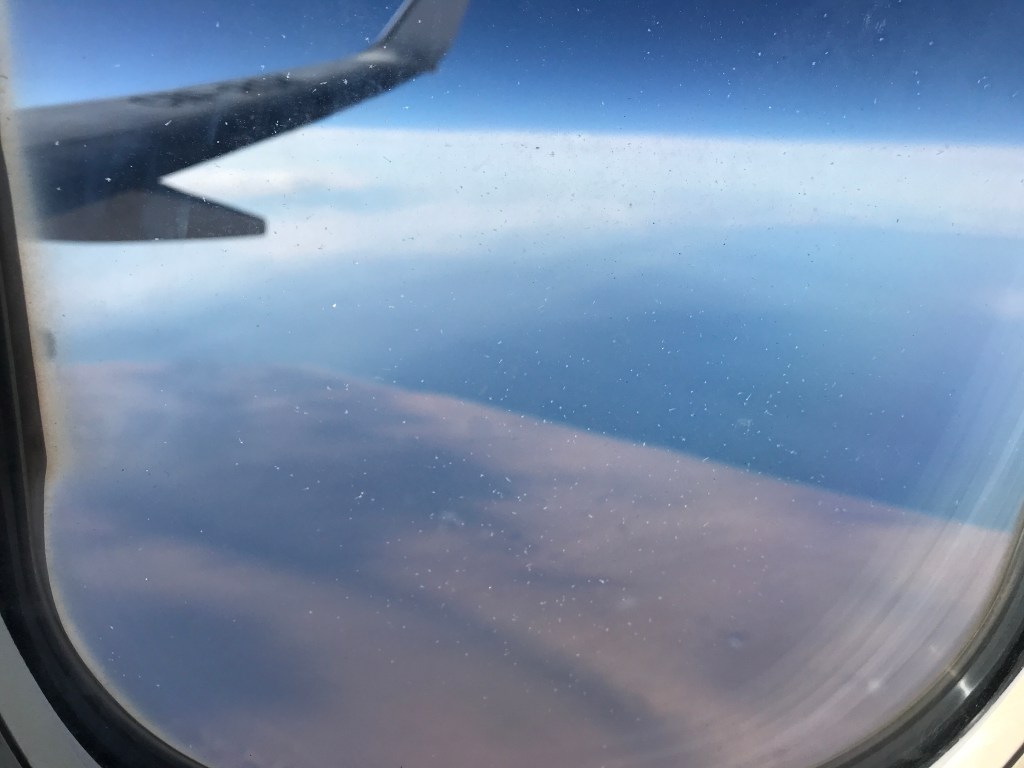
The flight took 2h 20m and was very enjoyable. Food and drink was served free of charge. Sitting on the right hand side of the 737, I had a great view of the Atlantic coast. South of Agadir, the land bordering the ocean turned inexorably from scrubland into desert. Soon there were just two colours at play: deep deep blue and serene golden yellow…
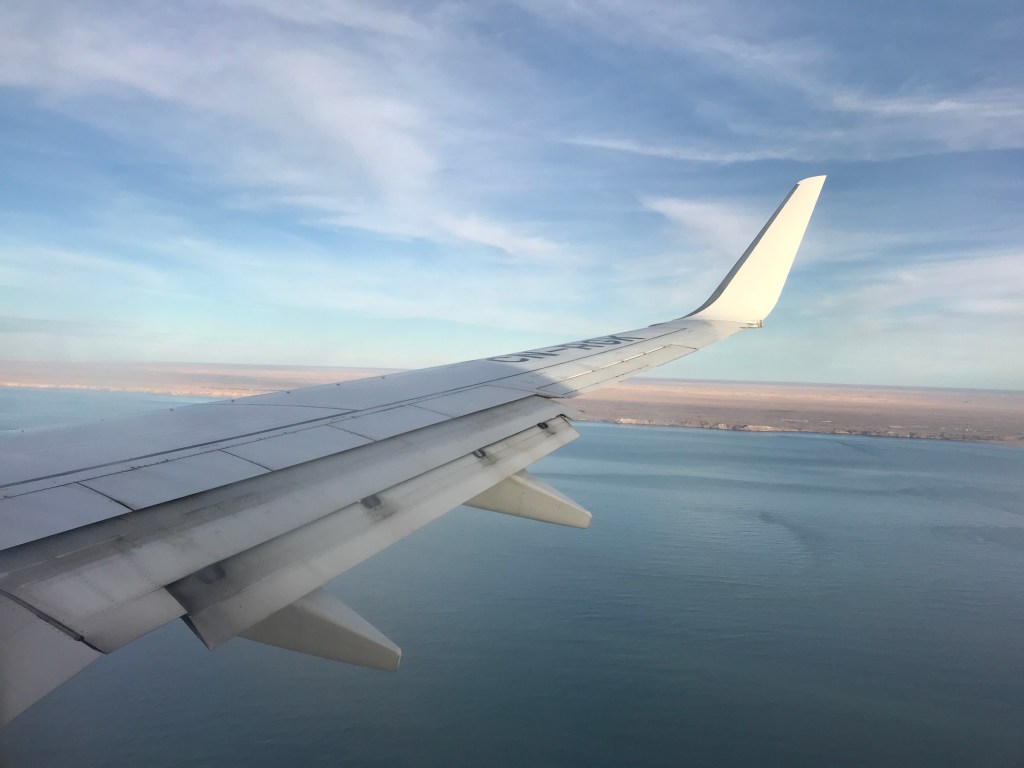
When we came in to land at Dakhla an hour or so before sunset, the city’s famous lagoon looked as still as a millpond. It was a beautiful sight – the vast desert stretching out behind it as far as the eye could see, and beneath us the city’s flat-roofed houses of two or three storeys, most in white, some in pale yellow, others in pale red or pink. We landed and disembarked, and I walked across the tarmac to the terminal building with a smile on my face.
No drama in Dakhla
Entry formalities were surprisingly light touch. As a UK national you can travel to Morocco’s Saharan provinces on the same terms as to the rest of the kingdom – that is, without needing a visa for stays of up to 90 days. Which makes Western Sahara probably the most exotic place you can get to with just a UK passport.
On arrival I was asked a few questions – my profession and the reason and duration of my stay – but at Dakhla airport (and elsewhere across the Saharan provinces) I was always treated with great courtesy by officials. And they were very appreciative of my efforts to speak their language.
As the sun was setting and the evening call to prayer sounded, I was checking in to my apartment at the lovely Dakhla White House a few miles north of the city. I can highly recommend it for its peaceful location overlooking the lagoon and its wonderful staff. Breakfast was served every day on the rooftop terrace, and they offered a laundry service which came in very handy as by now I was running out of clean clothes…
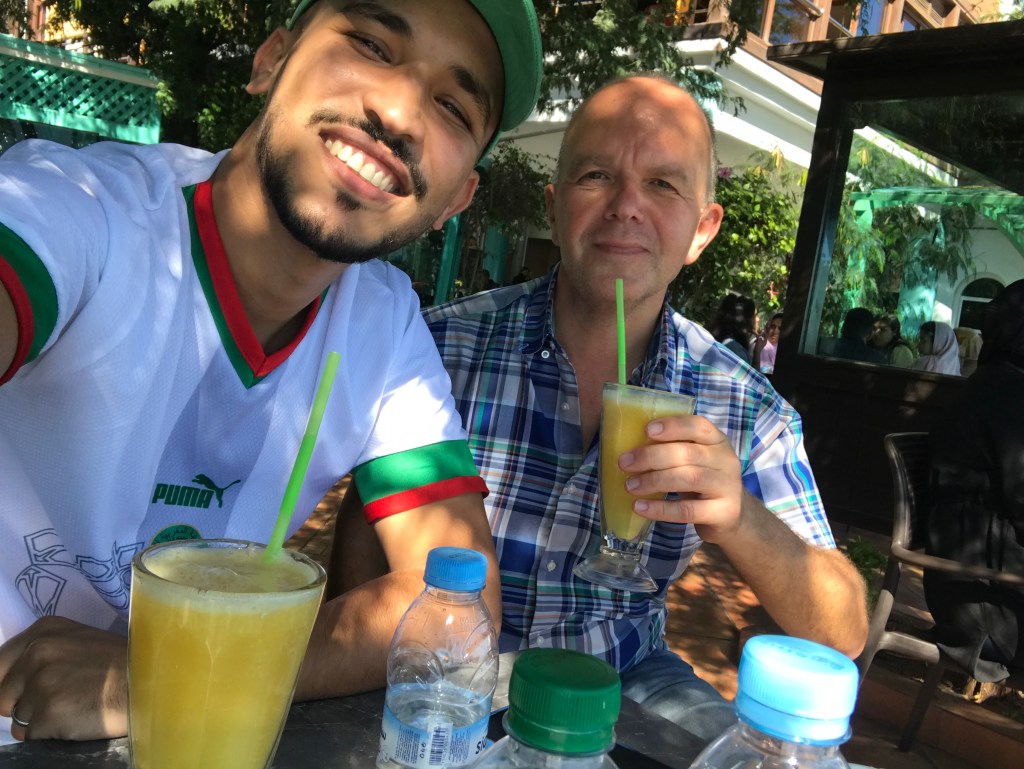
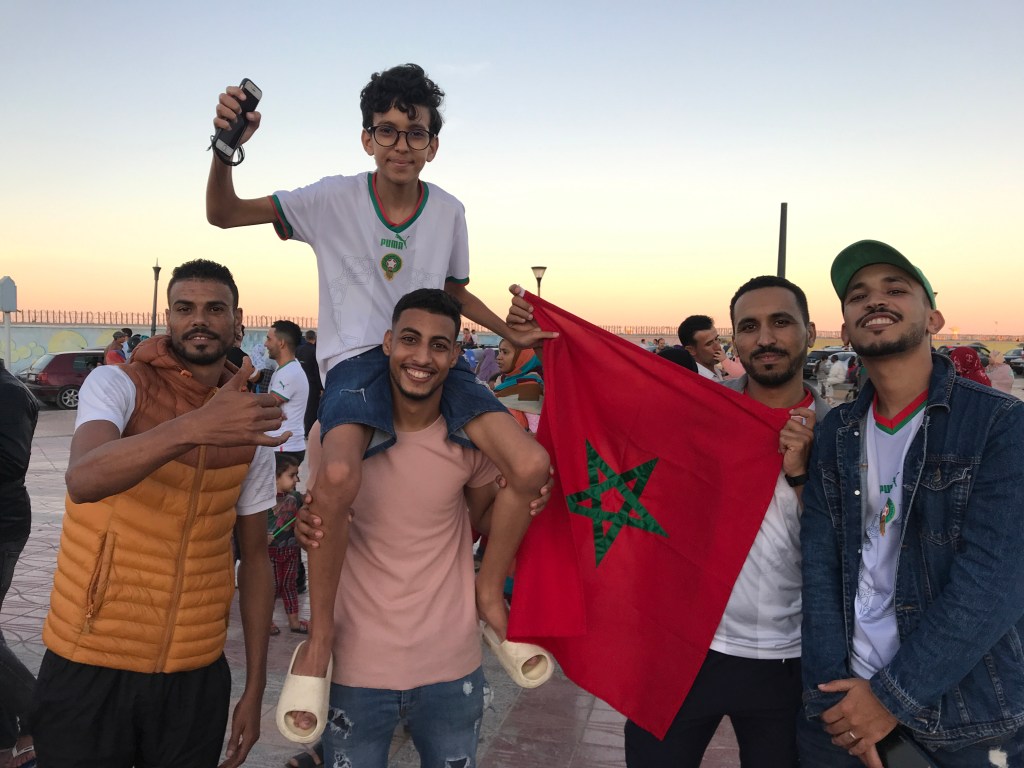
After a good night’s sleep I met up with Yassin the next day and was treated to a tour of the city. He took me to the souk, showed me the grand mosque and cathedral, walked me round his neighbourhood, and introduced me to dozens of his friends. We stopped for drinks at the nicely situated Café Terassa right by the lagoon and then grabbed some lunch before heading off to another café to watch Morocco v Portugal in the World Cup. The celebrations afterwards were huge – the whole town came out onto the streets to party.
At this point I will let my diary take over. I’ve kept a handwritten journal since 1985 – not writing every day, but whenever events and experiences inspire me. I take it with me on my travels; the pages become spattered with mud and rain and bleached by sun. Grains of sand fall from the pages decades later…
Boujdour, 12/12/2022
I walked six miles into the desert north of Dakhla, taking cunningly angled pictures that made it look as if I was in some remote lunar landscape. In reality, both the road and path were easy walking. I stopped to chat to a group of soldiers at a sentry post just outside the town after they beckoned me over with a wave and friendly smiles.
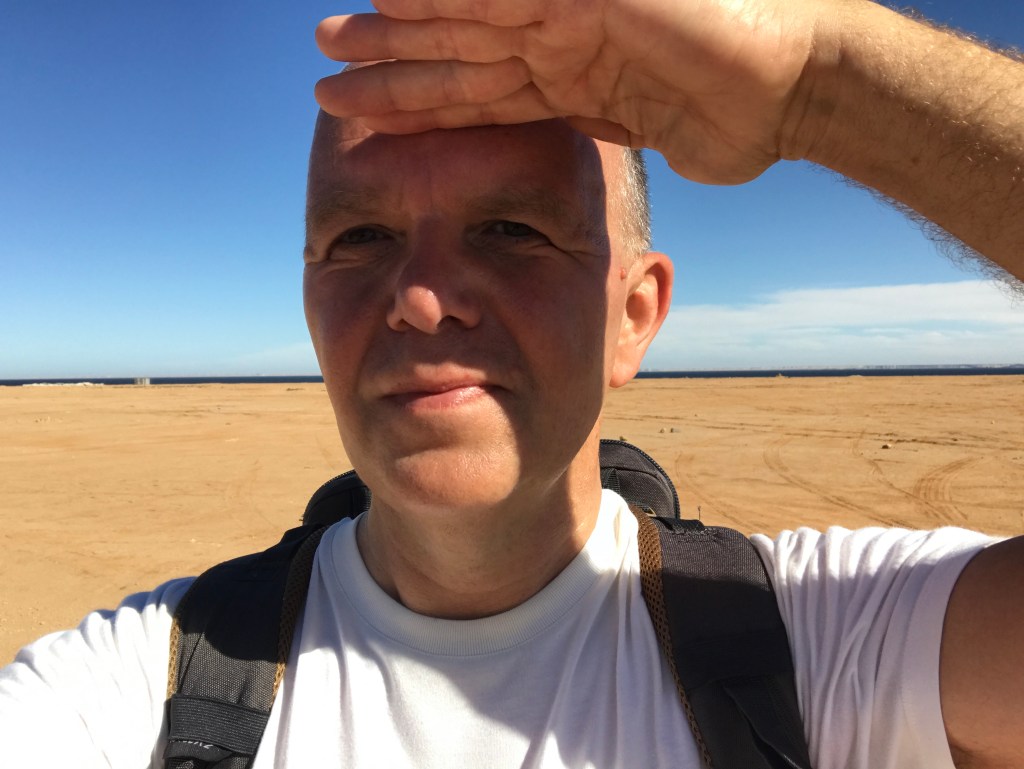
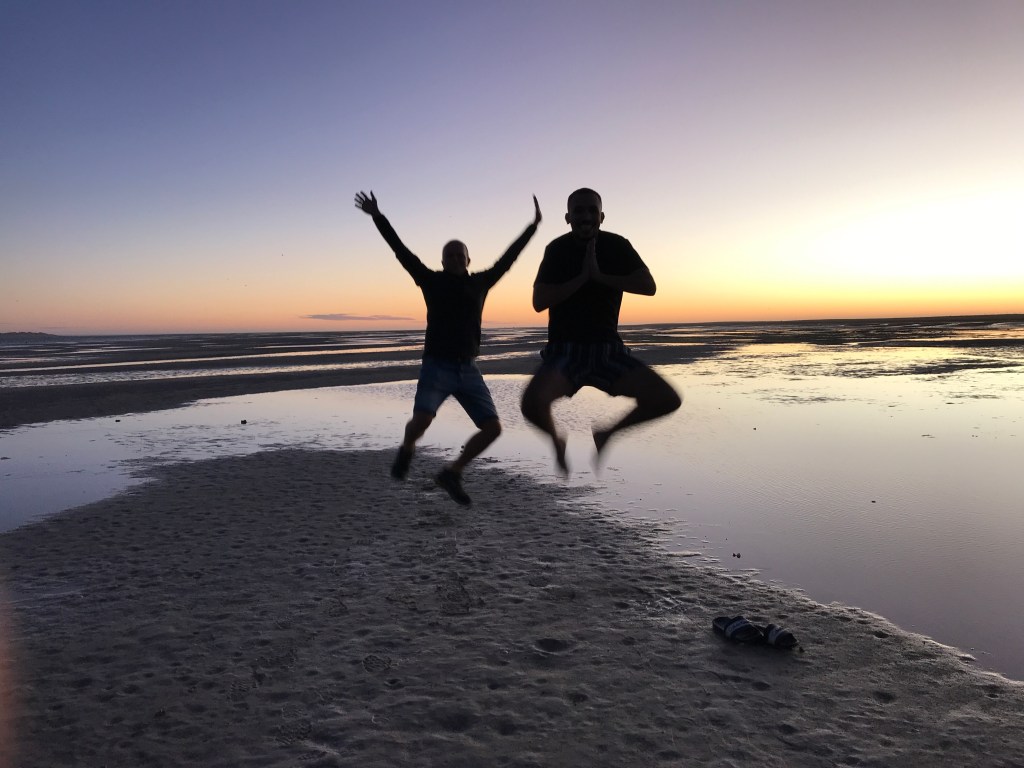
Then Yassin and his friend Marouane pulled up beside me and I jumped into their car, and off we drove to a little cove where I had a swim and we all shared a picnic. Later we watched the sunset at the north end of the lagoon – taking magical pictures of us jumping against a backdrop of crimson skies.
After not many hours’ sleep I forced myself out of bed this morning and packed my backpack. I had a final breakfast up on the terrace served by the lovely Noordin, bought some supplies for the journey at the supermarché, and said goodbye to the sweet young receptionists at Dakhla White House. Then to the dusty coach station for the 12:00 bus to Boujdour…
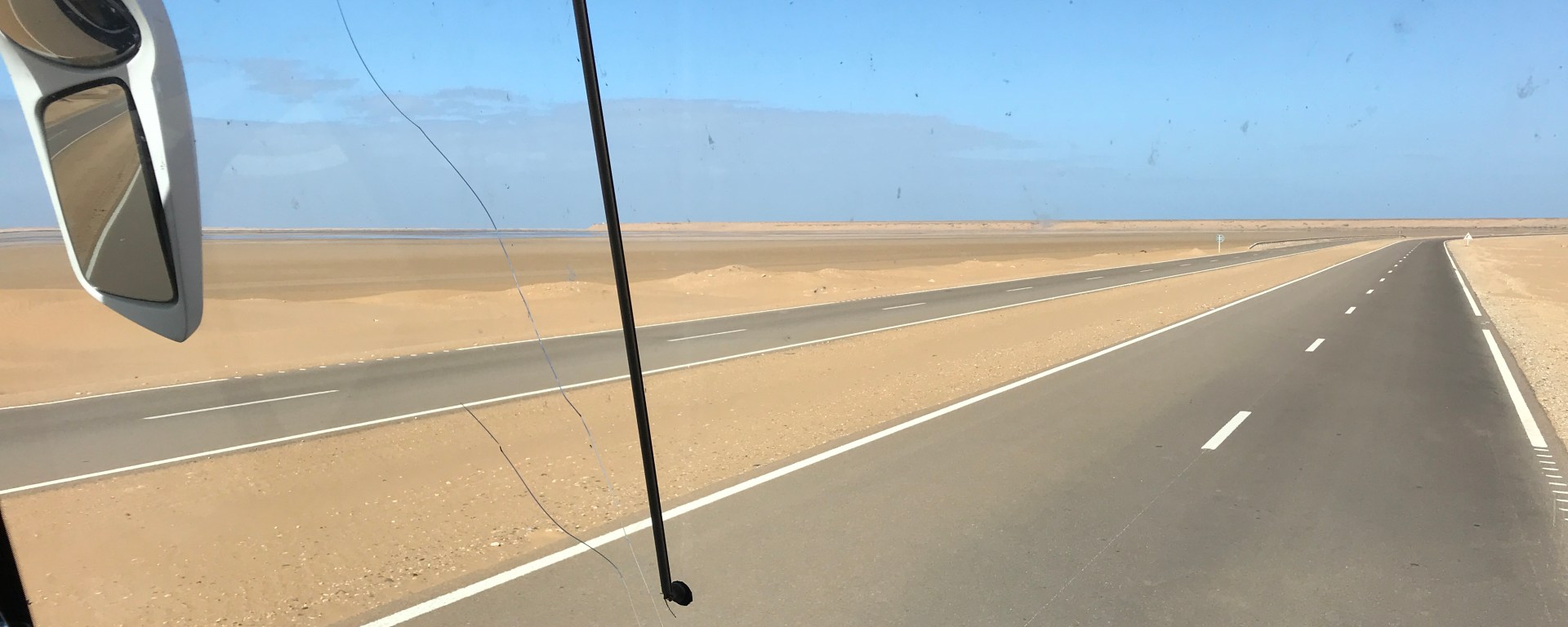
For the best part of five hours the landscape was desert desert desert. We had to slow down at one point to avoid some passing camels. Then we stopped at a petrol station in the middle of absolutely nowhere, and I stood astride the desert highway for a selfie with my new friends Aziz and Azdin. Two lads travelling overnight to Kenitra to take part in a police recruitment competition.
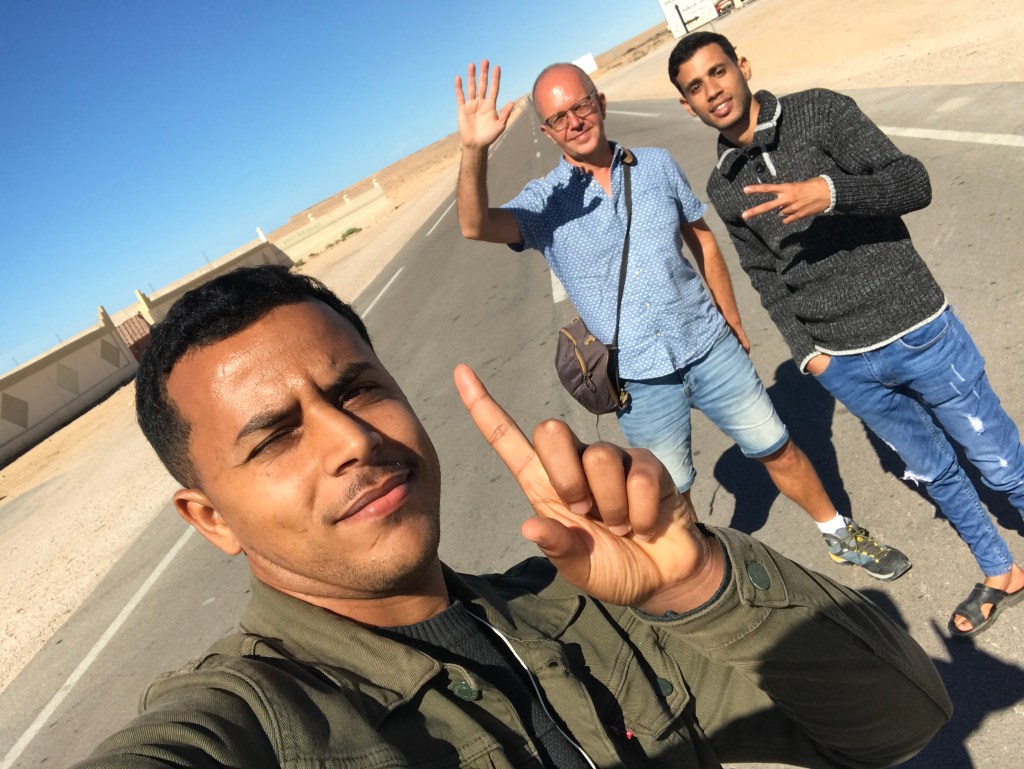
Back on the bus, a young father was sitting in front of me with his cute little son Ziad. I gave him so many sweets that he came round and kissed my knee!
Just outside Boujdour the bus stopped at a checkpoint and a policeman boarded. Where was I going? What was my profession? Ana moterjim, I said. He took my passport away for inspection while everyone whispered. But a few minutes later he was back smiling and wishing me bon chance, and on we went into this dusty Saharan town…
I was met by Younis, the brother of my Airbnb host Zakaria, and it was just a short drive to their house in the middle of town. It turns out that I am their very first guest. Everything here is very traditional: the shower is a bucket and scoop, and the toilet is a hole in the floor. The bed is a mattress on the ground by an open window.
Outside I hear no traffic but only the sound of children playing and neighbours chatting in the street. From what I can tell I’m the only European in town; a gang of kids ran up to me earlier on to say bonjour, ça va, and of course to shout MOROCCO in celebration of their country’s football triumph.
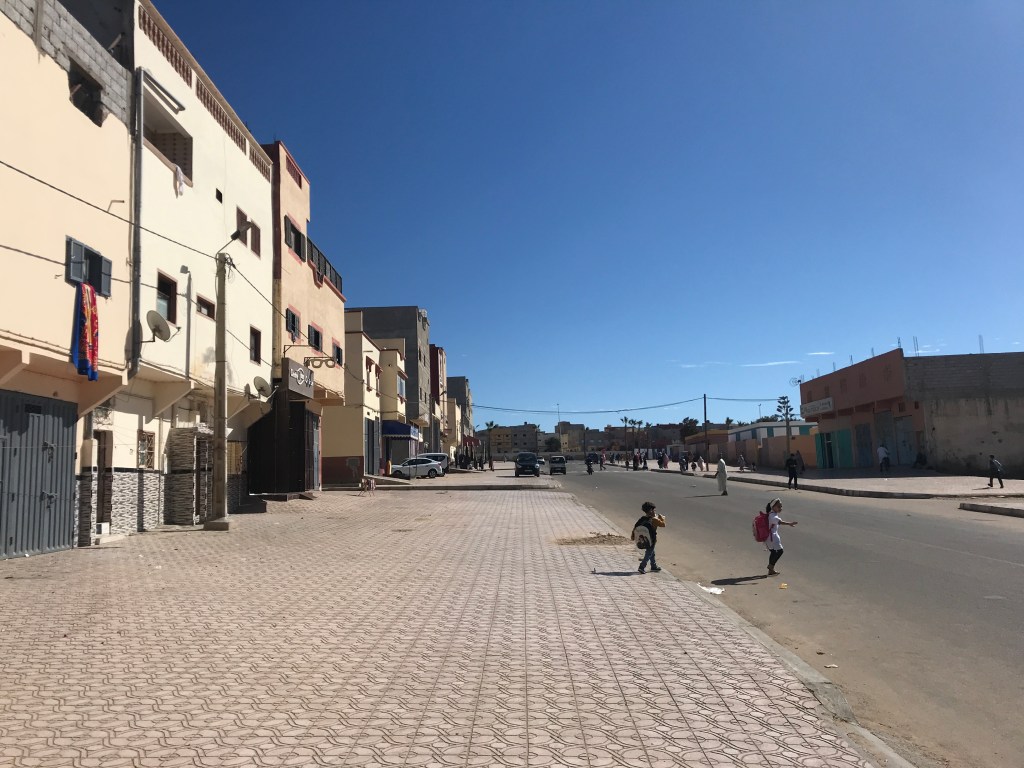
Laayoune, 14/12/2022
My 24 hours in Boujdour were one of the most intense travel experiences of my life. Goats roaming the dusty streets, camels growling, old men riding donkey traps, tiny little children skipping home from school with satchels on their backs, neighbours gossiping, butchers sharpening their knives, women sitting impassively in the shade of a wall, swathed in colourful robes.
But interestingly there were also glimpses of modern life: smiling young waitresses at cafés, not wearing headscarves; good fast wi-fi widely available; and smart 20-something young men dressed pretty much like their peers in Madrid or Casablanca.
Zakaria’s neighbour, also called Zakaria, took me back to the bus station this afternoon. Tall, handsome, and dressed in a traditional blue robe and sandals, he was forever smiling. We exchanged numbers – I have added his to my burgeoning Moroccan contact list.
But now I am in busy Laayoune, the biggest city of the Saharan provinces. Despite its population of over 200,000 I am treated like a celebrity wherever I go. A group of teenagers even asked if they could take a picture with me in McDonald’s!
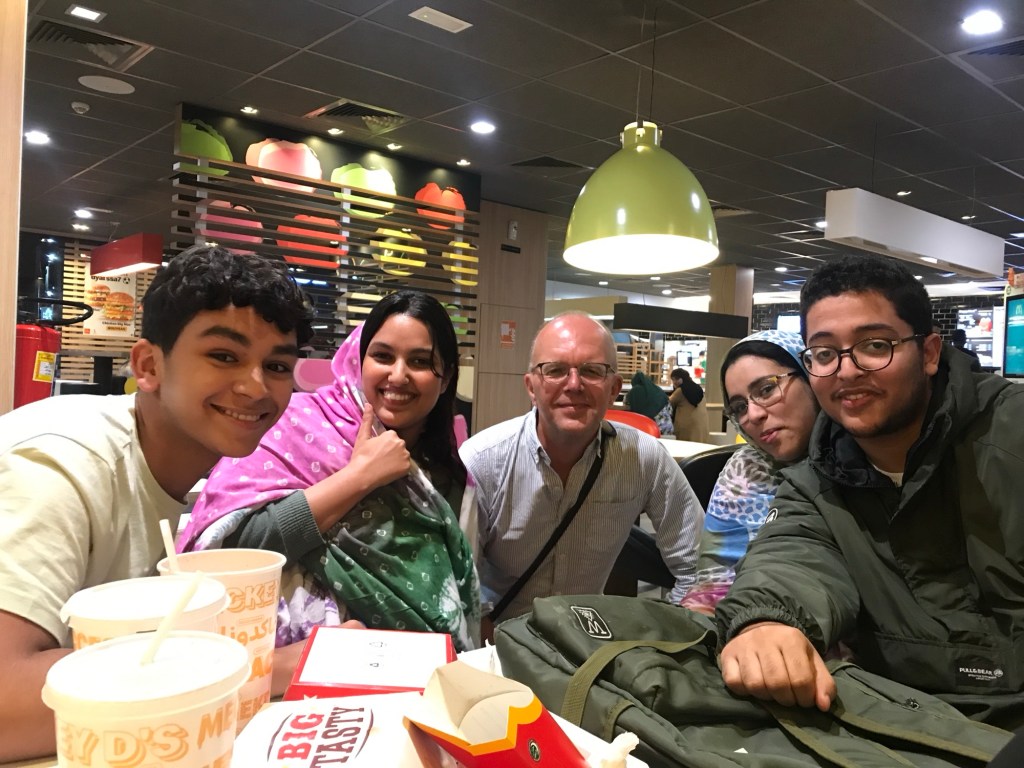
After remote, traditional Boujdour, my hotel room here feels plush and contemporary, with umpteen sockets, a TV with a hundred channels, and a European-style toilet (complete with vigorous bum-spraying device). Alas there was no water in the shower this morning – but this is the Sahara after all…
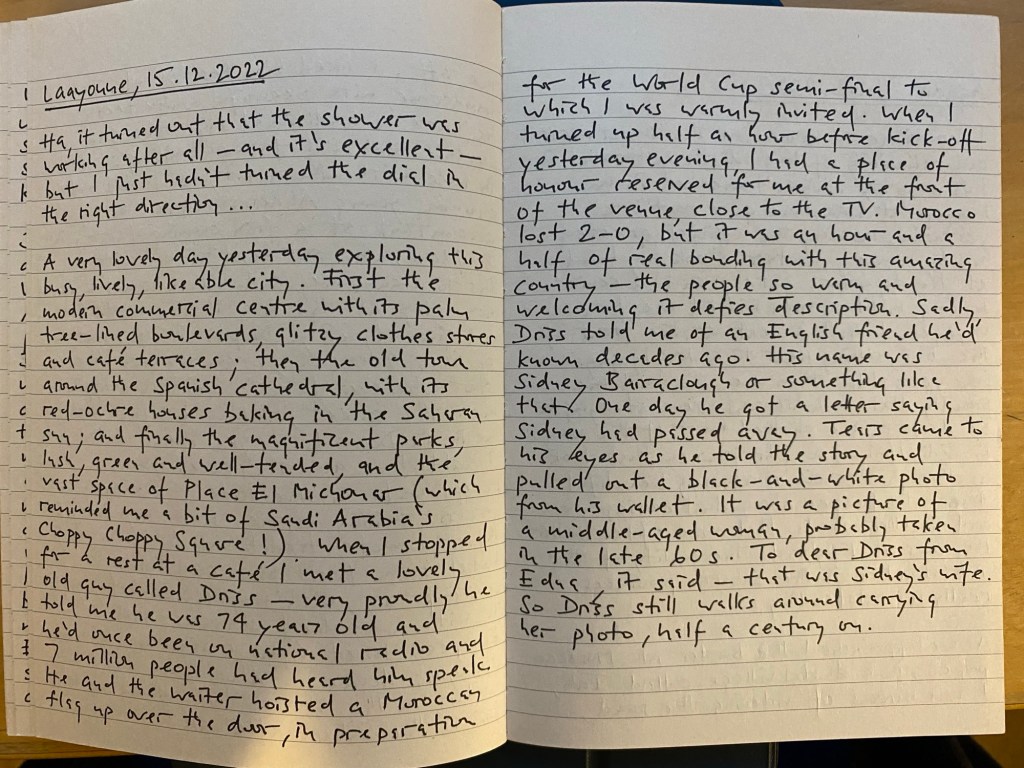
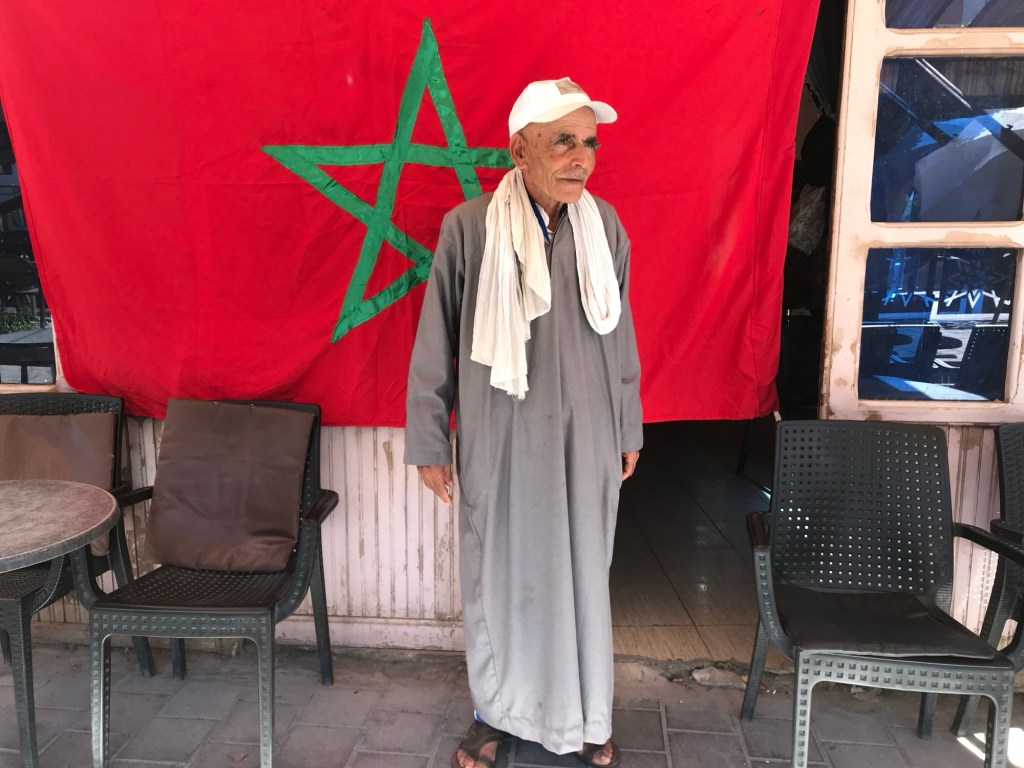
Sidi Ifni, 16/12/2022
I continue to marvel at the smoothness of long-distance travel in this vast country. When I checked in my baggage at Laayoune gare routière yesterday morning the official greeted me by name; another shook my hand at the departure gate; and a senior-looking military man solemnly wished me bon voyage.
I had a seat right at the front of the bus, sitting next to a lovely guy a few years older than me, who told me proudly that both his sons were studying to be doctors. We chatted all the way to Sidi Ifni, a 7hr journey that took us through Morocco’s achingly beautiful desert landscapes along dual carriageways that were often better than ours in England. The quality of the infrastructure in the Saharan provinces is really outstanding.
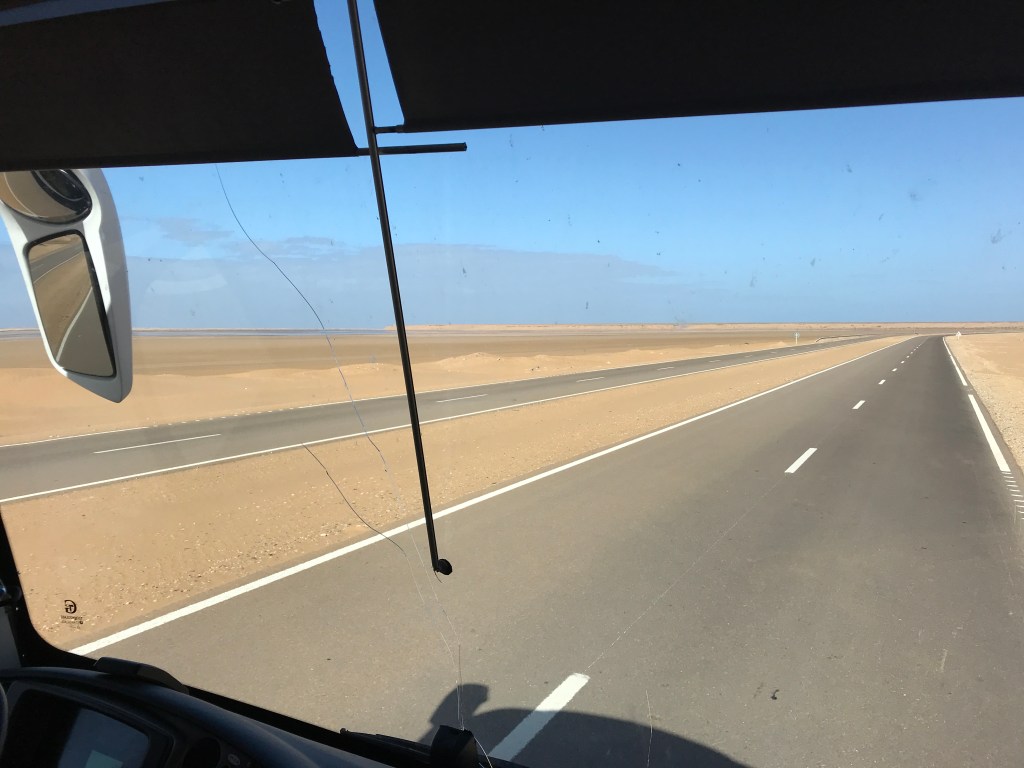
I stayed the night at Janna d’Ifni, a beautifully furnished guesthouse owned by a Frenchwoman called Aurelie, whose quiet and poised teenage son Mehdi let me into the building and showed me my room. I had dinner at a lovely little neighbourhood café, where as usual everyone praised my Arabic. Ifni is so tranquil, full of character – it is resolutely off the beaten track and has that dreamy quality of light you always get where mountains meet the sea. A Spanish exclave until 1969, the year I was born.
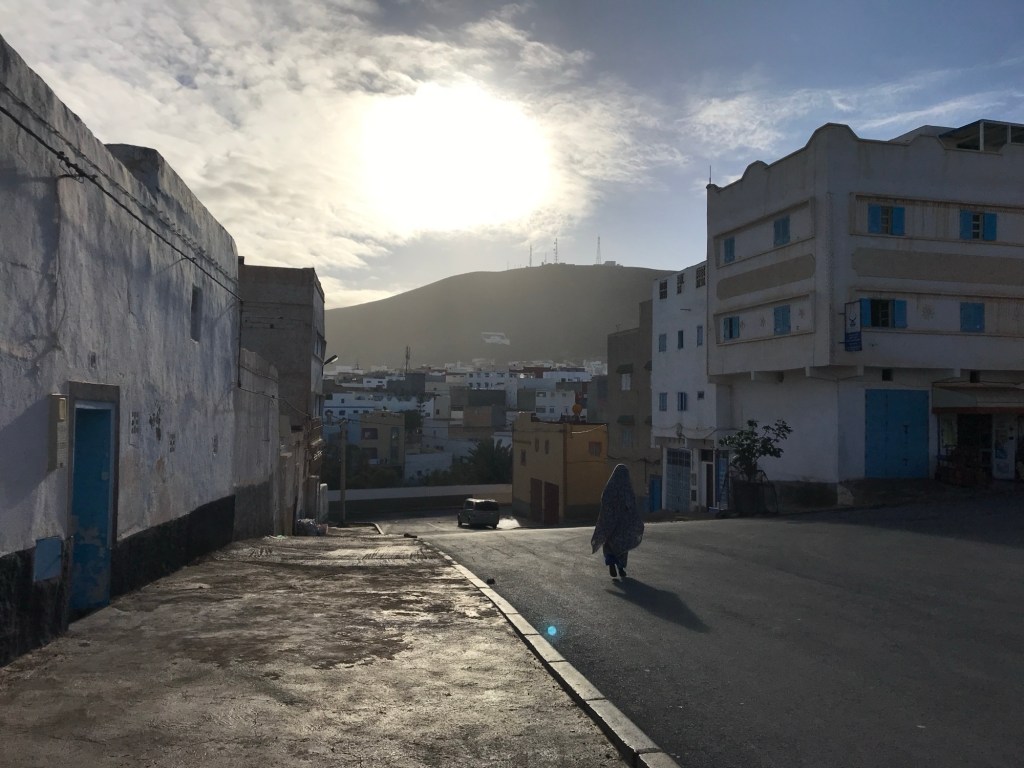
And now on to Agadir, but that will be another story…
 Lawrence Kuglin