
For the past three years I’ve had the great privilege of presenting evidence at the UK Covid-19 Inquiry.
Over the course of 10 modules, under the direction of the inquiry’s counsel team, I marshalled the electronic documents underpinning each hearing and displayed them on screens in the hearing room at Paddington.
They were then woven into the inquiry’s YouTube feed, and on some days made the TV news and the next morning’s newspapers.
Slide show
Someone once joked that I was just the slide show operator. But there was a bit more to it than that.
For three years, I had a front-row seat at Dorland House as first David Cameron, then Boris Johnson, Rishi Sunak, Matt Hancock, Chris Whitty, Patrick Vallance, Dominic Cummings, Nicola Sturgeon, Arlene Foster, Michelle O’Neill and countless other ministers, officials, experts and representatives of core participant groups all gave evidence.
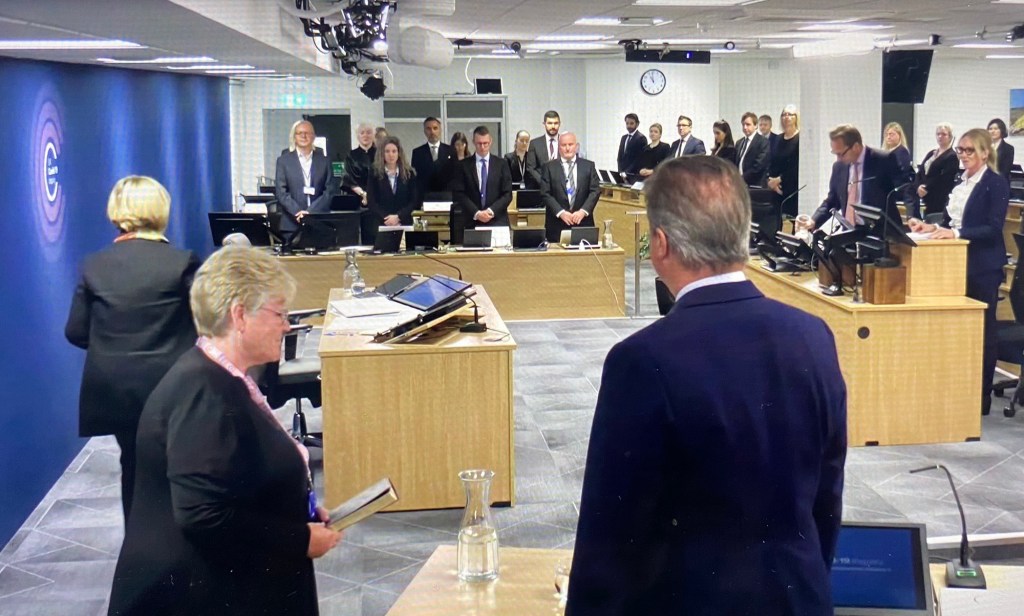
Sitting immediately to the left of the inquiry chair, diagonally across from the counsel bench and facing the witness stand, surrounded by screens and piles of paper and post-it notes, I was there from 8 every morning. Uploading the day’s evidence, processing last-minute doc refreshes, and always acting in close consultation with the team of solicitors and paralegals who are the compass and bedrock of the inquiry’s work.
Gossipy WhatsApps
Much of the documentation was highly sensitive. From gossipy WhatsApp messages to harsh email exchanges, the evidence shone an unsparing searchlight on the decision-making processes during the first frantic months of the pandemic.
It was crucial to make sure that the documents I was displaying were the right ones – at the right time, and with the right redactions. The cameras were rolling, the media and the public were watching, and the core participants were scrutinising every moment of an inquiry that meant so much to them. No pressure then!
Covid : The Opera
Whenever I met a new team at the start of a module, I would invoke a theatrical analogy. “It’s like putting on an opera,” I would say. With counsel the composer/conductor, and me perhaps playing an instrument (the oboe? the piano? the trumpet?) as the soloists sang.
The analogy was a serious one – I wanted to convey that you wouldn’t stage an opera without a score and a libretto, or without some element of rehearsal. So the hours of prep I put in each morning were a valuable opportunity to make my end of the operation as smooth and slick and reliable as possible.
“Panic early!” was always my motto. “Don’t leave anything to chance!” On busy days, when an ex-PM or a minister was giving evidence, I’d be at my desk as early as 7.30 for a 10am start. I didn’t want to risk embarrassing errors undermining this big public event.
Bowl of spaghetti
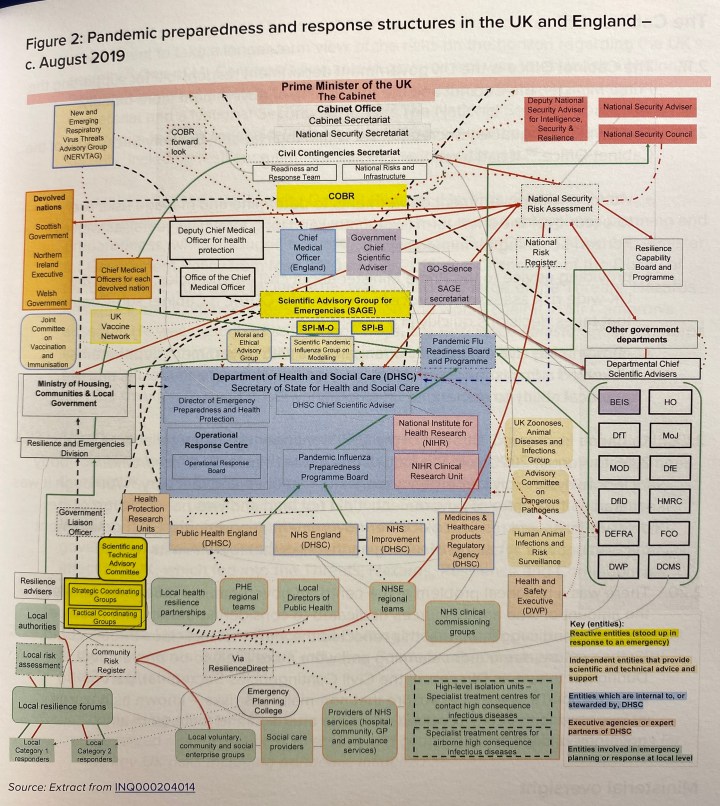
The famous “spaghettigram” was one of the first pieces of evidence I was asked to display. Created by the inquiry team to illustrate the complexity of the UK’s resilience architecture, it was a spider’s web of official bodies all rendered in the tiniest of tiny writing. With a bit of prep, I was able to take viewers round it with the help of my annotation tools – so everyone knew where we were and what we were talking about. One way I was able to add value to proceedings.
Five insights
I take my duty of confidentiality to the inquiry very seriously, so this is no gossipy kiss-and-tell (not that I was privy to much gossip – or any kisses).
But now that my work on this mammoth process has come to an end, I’d like to share five observations from the last three years.
- The inquiry has been enormously thorough, and rightly so. When inquiries are announced, there’s simultaneous pressure for them to be both swift and forensic. They cannot be both – and any commitment to rigorous investigation inevitably comes at a price in terms of time. But there is no point in holding an inquiry if its work is only skin-deep. Covid was a once-in-a-century emergency of such breadth and magnitude that it always deserved and required the deepest analysis.
- The inquiry has been led with firmness and compassion by the chair, Baroness Hallett. I’ve been watching M’lady at close quarters for almost three years, and have consistently been struck by her humanity and approachability. She is often moved to tears by personal testimony from the Covid bereaved. But she does not tolerate rudeness, and she insists on decorum – we all remember the time she told off a witness for taking the oath with his hands in his pockets… She has been determined to stay focused, and her countenance darkened whenever questions meandered or answers went off-piste. And she was clear from the outset that she would not stray into politics. She never allowed the hearings to be misused as a political soapbox.
- The inquiry has been an exceptionally kind and supportive place to work. This is in large part a reflection of the chair’s influence. People are appreciated and recognised at every level of the operation. It has felt like a genuine family – and one that unusually doesn’t row. There are so many people involved that it’s impossible to mention them all, but my special thanks go to the wonderful team of ushers who looked after us like a troop of indulgent mothers. And of course to the highly professional security team who kept everyone safe. We owe them a big debt of gratitude. Backstage, Laura’s cakes were also legendary…
- And what of the politicians? I’ve been fascinated to see how overawed many of them are when they first enter the hearing room. People we were accustomed to watching on TV announcing draconian restrictions on our daily lives suddenly found themselves uncomfortably under the spotlight, confronted with the tortuous twists and turns of their decision-making. “Did you or did you not do that?” thundered one KC whenever witnesses obfuscated.
- Amid the fraught exchanges, there were also moments of comedy. One witness told the inquiry that the accusations levelled against him were frankly “bollocks”. His colourful language prompted Counsel – in this case one of the most mild-mannered KCs – to voice fears that his next question might raise the elderly peer’s blood pressure even further… Another witness – a controversial figure from the Johnson era – apologised for his bad language as he was escorted out of the hearing room at the end of a long and sweary day. “It’s OK,” said the weary stenographer, barely looking up. “We’re used to it.”
A job well done
Yesterday, then, was the final day of the public hearings. A day of reflection and a little sadness – but also a big sense of a job well done by everyone involved. For me, a little moment of pride when dear Claire Mitchell KC name-checked me in her words of thanks on behalf of Scottish Covid Bereaved.
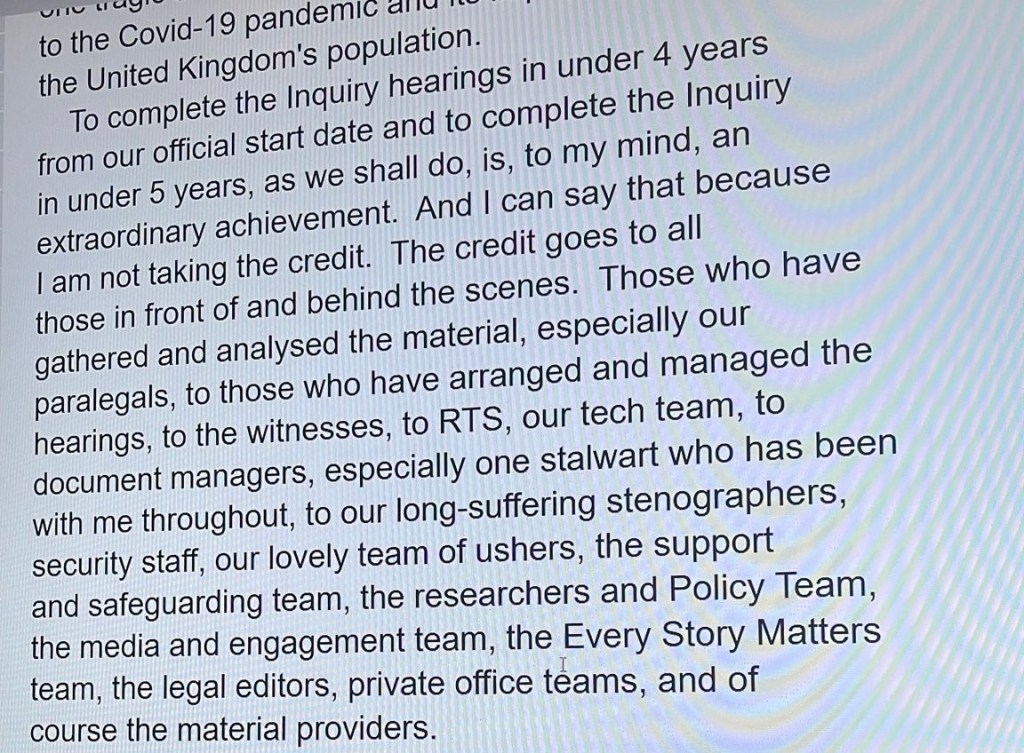
And I wonder who M’lady was referring to when she mentioned “one stalwart who has been with me throughout”? It was a lovely moment that I will cherish.
The work of the Covid Inquiry goes on even now that the public hearings are over. The remaining reports must be written and published, with the final ones due in the first half of next year. And then it is over to the government to ensure that M’lady’s recommendations are fully implemented.
But for me, the work of evidence presenting is over. It was a phenomenally interesting episode in my life, and I’m enormously proud to have played a part in this event of national importance.
 Lawrence Kuglin