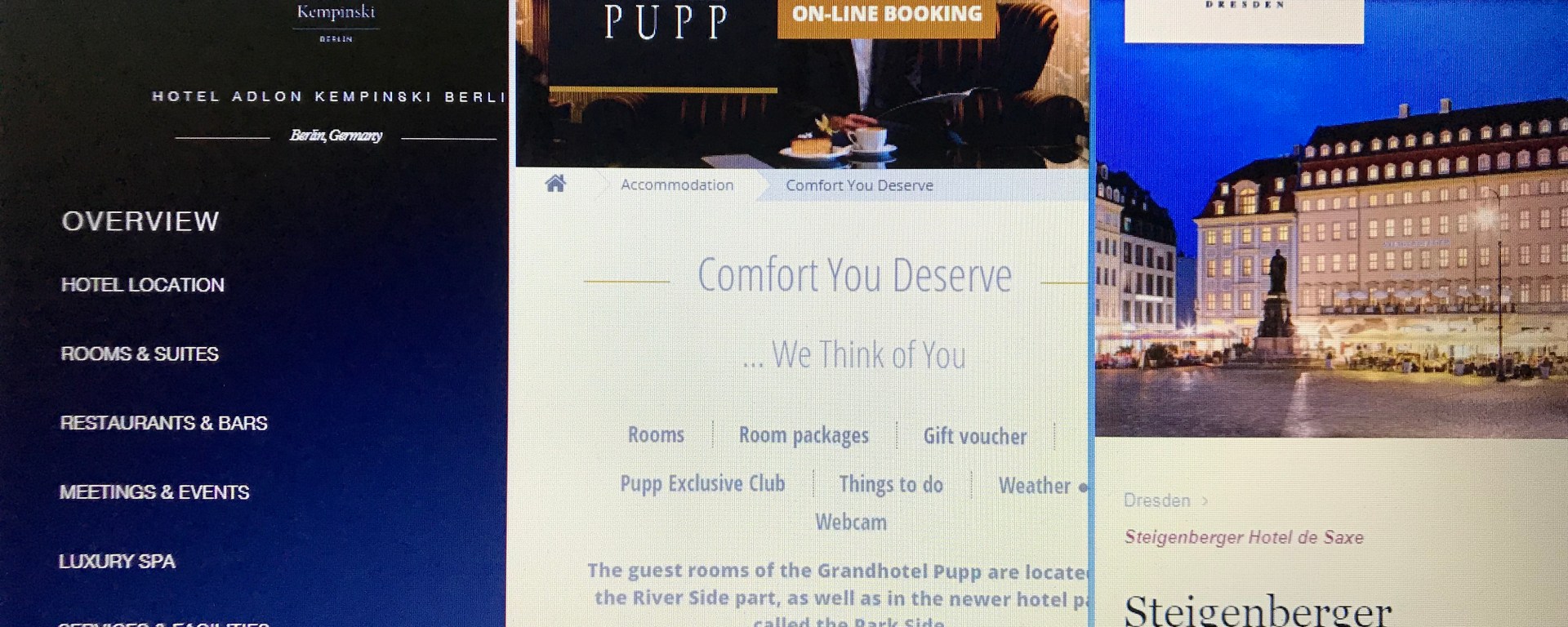
I’m working with hotels in a number of European countries to improve their English language web content. From mountain lodges to boutique hotels and 5-star luxury wellness retreats, I’m helping them to sharpen their digital copy and make it clear, concise and inspiring.
Often I’m dealing with content that’s been rather clumsily translated from the home language – be it German, Czech, Polish or Hungarian. Nuances have been lost along the way, grammar remorselessly shredded, and often it’s a struggle to make any sense at all of the long, stilted sentences.
One hotel I looked at recently described its conference room like this: “It is rich in decoration and daily light, surrounded also by private garden, ideal for service of refreshment outside of the meeting space.” Another boasted that: “Walking shower with a tropical rain enhances an excellence of this suite.” And a 4-star hotel in one popular European city break destination warned that “lonely children” were not allowed to use its facilities…
First impressions
Why does all this matter? Well firstly, a hotel’s website is usually its first point of contact with a potential customer – its shop window on the world. The impression it makes on visitors can be crucial in converting page views to bookings. Are you really going to stay at a luxury hotel that trumpets its commitment to excellence when the website is written in schoolboy English?
Good communication
Secondly, a hotel website is trying to communicate some very basic info – what facilities do the rooms have, when are the bar and restaurant open, how far is it from the hotel to the station? People’s patience and attention spans are getting ever shorter – too many clicks needed to access the info and they lose interest. So the more concise, the better.
Crystal clear
The content should also be crystal clear. Inaccurate vocabulary risks confusing and alienating potential customers. I’ve lost count of the number of European hotel websites I’ve seen that highlight the “warm breakfast buffet” or the “climatisation” in the rooms. When the language isn’t spot on, the natural reaction is to question the quality of the service.
Seek to inspire
Finally, hotel websites should strive to be inspiring. After all, they are often trying to persuade prospective guests to part with a lot of money. Yet many luxury hotels present the amenities in their lovingly designed rooms in the form of a laundry list – all the way down to the “window that opens” and the “free bottle of sparkling mineral water”.
So I always advise my clients to make some space for a short descriptive piece that gives their visitors a sense of what it would feel like to stay in one of those beautiful rooms or suites, to hang out in the lobby bar, or to dine in the restaurant.
The rationale for this is simple – to draw the guest in and make them feel involved, even before they’ve completed the booking. To make them imagine themselves there already – enjoying every minute of their stay.
Contact me
If you’d like me to refresh your hotel’s English language web content, please use the contact form to get in touch.

